


For the First Time: The Food Cost and Food Safety Templates We Use
Keeping flavor, quality and numbers consistent gets harder as a bar, coffee shop, bakery or pastry shop grows. More staff, more recipes and more suppliers mean more room for drift.
We are often asked how to hold that line. The honest answer is not exciting: systems. The same numbers, the same steps and the same records, every shift.
The Cosmos Society Working Files are that system. Until now, they were only available to our consulting clients and private customers, set up as part of our work with their teams.
Today, for the first time, we are putting the complete toolkit on our website. These are the same spreadsheets, calculators and logs we use in our own bar, coffee, pastry and fermentation projects, and to mark the release they are available at a special price.
Below, we explain what each tool does and how to use it, for bartenders, baristas, bakers, pastry chefs and owners. You can download the full navigator for free and read the instructions for every file.
Who These Templates Are For
The toolkit is not only for bars. We have used these files in bar programs, coffee service, a pastry kitchen and fermentation production, and each type of venue leans on a different part of it.
Bars and cocktail programs: Cost Calculator, Tech Cards, Prep Plan, Opening and Closing Checklists, Menu Engineering.
Coffee shops and cafés: Coffee Waste and Plant-Based Milk Margin Calculator, Ready-to-Sell Cost Calculator, Inventory.
Bakeries: Dough Hydration Calculator, Sourdough Starter Log, Prep Plan, Schedule.
Pastry shops: Cost Calculator for micro-portions, Specs sheets for foams and creams, CCP Logs, Daily Sales and Cash-up.
Fermentation programs: Lacto-Fermentation Sugar Calculator, Fermentation Log, Bonus: Basic Lacto Sodas.
What’s Inside the Cosmos Society Working Files
The package contains 25 files in five blocks, plus a free navigator. Most files are Excel spreadsheets; the CCP guide and the two fermentation logs are printable PDFs.
Economics and food cost (6 files): recipe costing, ready-to-sell pricing, coffee waste and plant-based milk margins, menu engineering, daily sales and cash-up, P&L with payroll.
Technology and recipes (5 files): specs sheets, dough hydration, lacto-fermentation sugar, fermentation and sourdough starter logs.
Kitchen and bar management (7 files): prep planning, suppliers, onboarding, schedule, inventory, ordering and goods receiving, equipment and maintenance.
Physical control (6 files): checklists, CCP logs and guide, fridge temperatures, write-offs, allergen matrix.
Bonus (1 file): basic sodas and core ferments, ready to batch.
Every spreadsheet follows the same logic. You fill in the input cells; the calculated cells update on their own. Currency and tax are set by you, so the files work in any country.
Food Cost Calculator for Cocktails, Coffee and Pastry: Know Every Gram
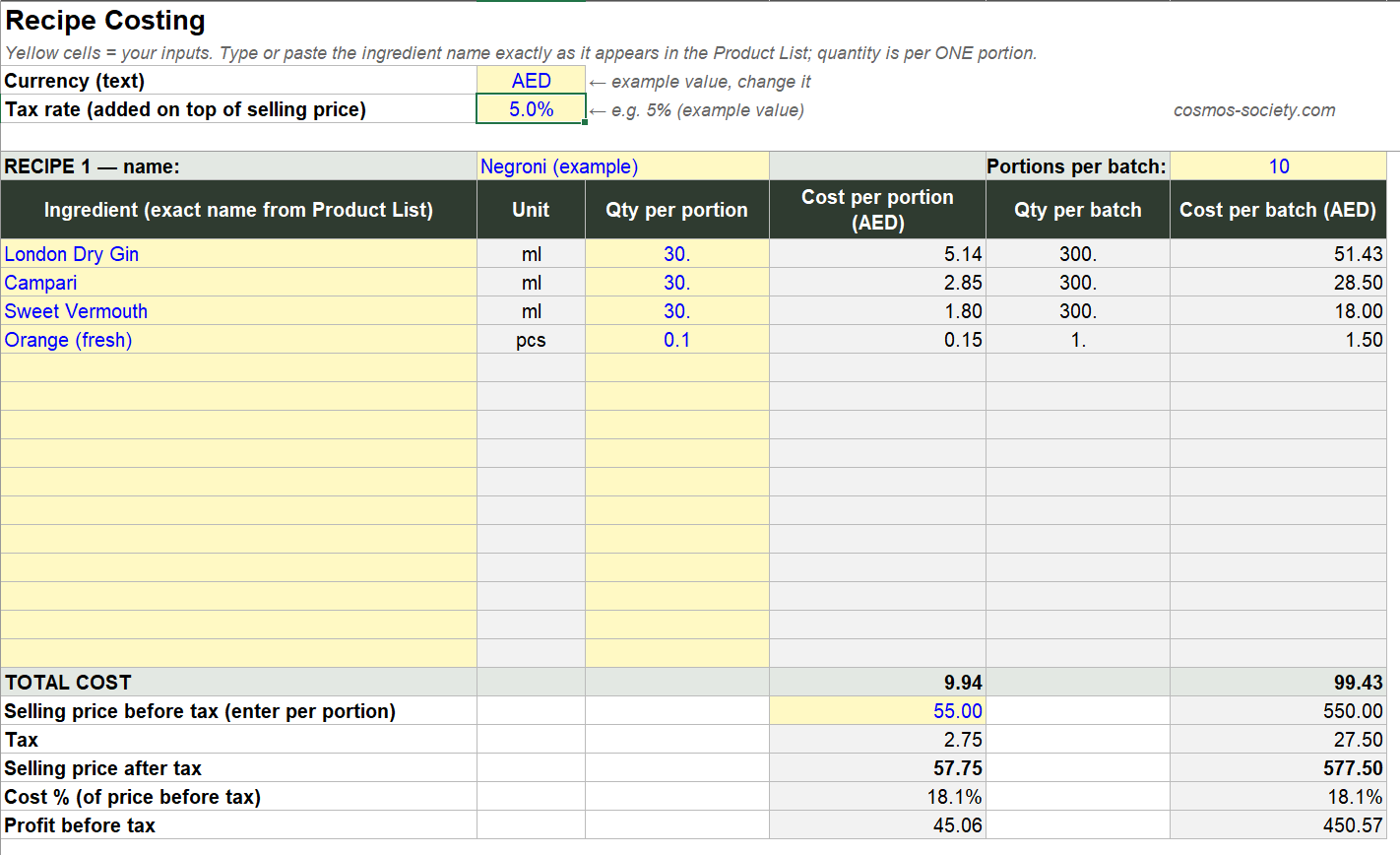
Cost Calculator. This is the base file. You enter the price of a whole pack once, in the Product List, and the sheet works out the cost of every gram, milliliter or piece. Then you paste the product name into a recipe and enter the quantity per portion.
You never cost micro-portions by hand again. Twenty grams of agar-agar, three grams of vanilla paste in a crémeux, a tenth of an orange in a cocktail: the sheet prices each line from the pack price. Enter the number of portions and it scales the recipe to a batch, then shows tax, price after tax, cost % and profit.
Ready-to-Sell Cost Calculator. For items that need no preparation: a glass of wine, a bottle of water, a protein bar or a bottled juice on a café counter. Enter the pack price, the portion size and the selling price after tax. The sheet returns portions per pack, cost per portion, cost %, profit and a suggested price at your target cost %.

Coffee Waste and Plant-Based Milk Margin Calculator. Built for coffee shops. Standard costing ignores the morning espresso dial-in and the milk left in the pitcher. This calculator spreads that waste across the drinks you sell. You see the real cost of a cup, the real margin on plant-based milk and the hidden monthly loss.
Recipe Specs, Bakery Dough Hydration and a Lacto-Fermentation Sugar Calculator
Specs. An empty form for your own bar and production recipes, on five sheets: non-alcoholic cocktails, cocktails, ferments, solutions and infusions, foams and garnishes. Enter portions per batch, or a batch multiplier such as ×2 or ×5, and every quantity rescales. Ingredients added after the first stage sit below a thick line, so nobody adds them too early.
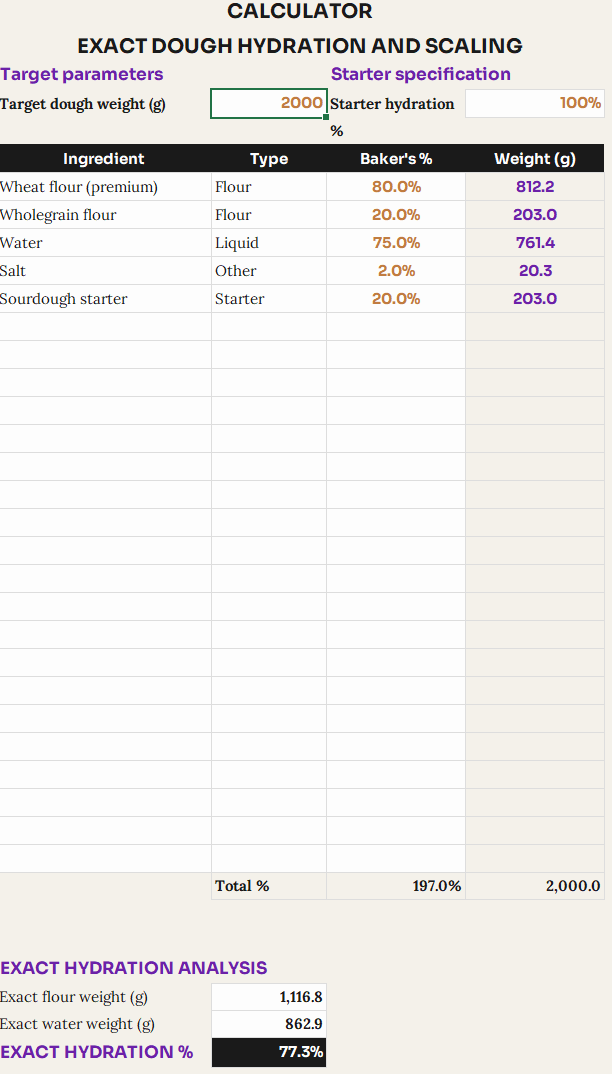
Dough Hydration Calculator. Built for bakeries and pastry shops that work with sourdough. A starter carries its own flour and water, and most hydration maths ignores it. Enter your baker’s percentages and the starter’s hydration. The sheet scales the dough to your target weight and shows the exact hydration, starter included.
Lacto-Fermentation Sugar Calculator. Lactic acid bacteria and wild yeasts compete for the same sugar, and the sugar level decides which side wins. We work in a range of 8–12 g of sugar per 100 g of mix. Enter the “of which sugars” value from the puree label, the weights and your target. The sheet tells you how much sugar to add and how much water to use.
Fermentation Log. A printable form for one batch: starter, recipe, then time, temperature, pH and Brix at every check. Each column explains what to record, and the last section captures adjustments for the next batch.
Sourdough Starter Log. Day-by-day instructions for building a starter from 625 g of wholegrain flour and 625 g of water, plus a feeding log. It covers the 1:1:1 feeding ratio and how to wake a refrigerated starter before baking.
Par Level Prep Planner and Operations Templates for Bars, Cafés and Bakeries
Prep Plan (Par Level). Set a target stock for each prep once, with its shelf life and lead time. Each day, enter what is left; the sheet shows exactly how much to make. Start with long lead-time items, such as croissants that need three days or a kombucha batch that needs a week, before the stock runs out.
Supplier and Product Database. One place for every supplier: company, contact, phone and email. Each product has a primary and an alternative supplier, so an empty shelf at one supplier does not stop service. The file is easy to hand over when a manager changes.
Onboarding: New Bartender’s First Day. A two-block induction checklist. The bar manager covers philosophy, rules and expectations; a mentor bartender covers the venue, the team and safety. Both sign at the end of the day. The same structure works for a new barista or baker.
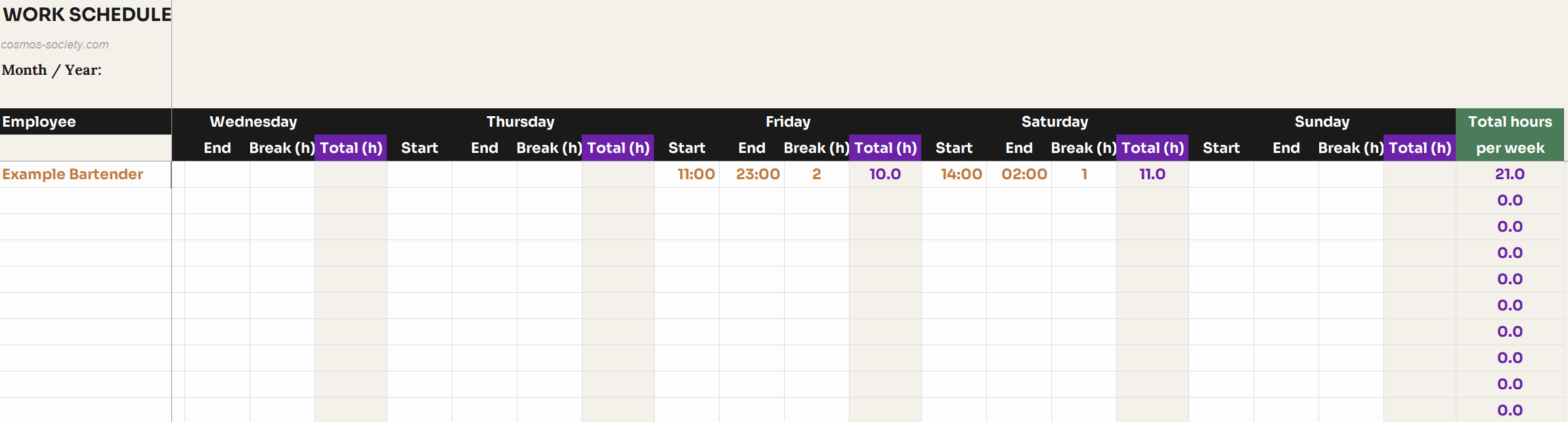
Schedule. A weekly shift schedule that counts hours per day and per week, breaks included. Shifts that run past midnight are counted correctly.
Inventory. A 50-line stock count that adds full containers and open remainders. It still counts a single open bottle when there are no full ones.
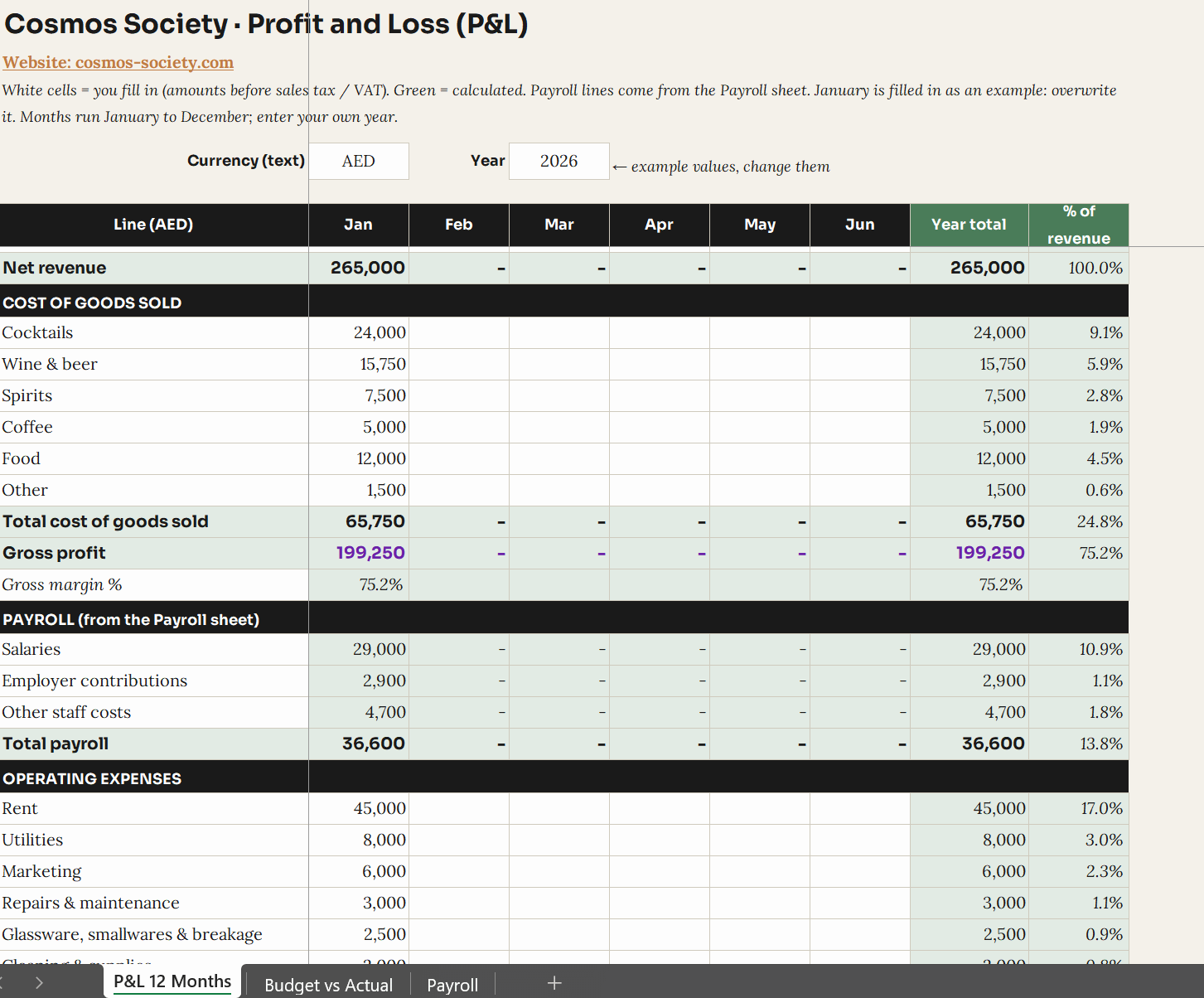
Profit and Loss (P&L) with Payroll. Food cost is only one line of the story. This workbook brings the whole month together: revenue by category, cost of goods, payroll, operating expenses, EBITDA and net profit, with prime cost % and cost % by category. A payroll sheet turns salaries, employer contributions and benefits into monthly totals that feed the P&L, and keeps service charge and tips separate from revenue. A budget-vs-actual sheet shows, for any month, where you beat the plan and where you missed it.
HACCP Log Templates for Bars, Coffee Shops, Bakeries and Fermentation
Fermentation is controlled spoilage, and the control part needs records. Creams, fillings and dairy in a pastry shop or café need the same discipline. This block turns food safety from a folder on a shelf into daily habits.
Opening and Closing Checklists. The same order of steps for every shift, plus a weekly bar-readiness check at 12:00. Reference sheets list the par level, shelf life and freezability of each prep.
Critical Control Point Logs (CCP Logs). List your critical control points once, with numeric limits. In the daily log, pick the CCP and enter the reading; the status shows “Within limit” or “DEVIATION” automatically. A deviation goes into the corrective action form: what happened, what was done with the product, the cause and who decided.
Critical Control Points Guide (CCP Guide). A six-page PDF that explains CCPs, critical limits and corrective actions in plain language. It walks you through finding your own CCPs with a four-question decision tree.
Refrigerator Temperature Log. A printable sheet to hang on the fridge door: date, unit, target and actual temperature, signature and corrective action.
Write-Off Report. One sheet per day of the week for product written off or used in testing, with the reason, signed by the bartender and the bar manager. Recurring reasons show which preps or volumes need to change.
The reference limits in the guide are a starting point, not a regulation. Confirm them with your local authority and a food technologist.
Bonus: Basic Sodas and Core Ferments
The bonus file holds nine recipes in the same tech card format, with batch multipliers and full instructions.
Core ferments: milk kefir, milk kefir whey, plain tibicos (water kefir) and classic rye kvass. These are the starters the other recipes build on.
Sodas: guava tibicos, mango and whey soda, mandarin soda, kumquat tibicos and blueberry soda.
Each recipe lists fermentation temperature and time, when to strain, how to rack off the sediment and how long to store it. Check the sugar of any new soda in the Lacto-Fermentation Sugar Calculator before you scale it up.
How to Start: The Order We Use on a New Project
Specs. Write down your recipes and preps first; everything else depends on them.
Product List and Cost Calculator. Enter pack prices and cost the menu.
Ready-to-Sell Cost Calculator. Price the items that need no preparation.
Supplier Database and Prep Plan. Set up purchasing and daily prep.
Schedule, checklists and onboarding. Set up how the team works, and take inventory weekly or monthly.
CCP Guide, then the logs. Find your critical control points and start the temperature log and the CCP logs.
Why Now: Our First Public Release, at a Special Price
Until today, the only way to get these files was to work with us. To mark their first public release, we're lowering the price for a limited time: the full package usually goes for 75 USD, but now it's 39.50 USD.
Not sure yet? Download the navigator for free. It describes every file, what it is for, how to use it and what to watch out for, so you know exactly what you are getting.
Frequently Asked Questions
What format are the files? Sixteen Excel spreadsheets (.xlsx) with standard formulas and three printable PDFs.
Does it work in my country? Yes. You set the currency and tax rate yourself, and all recipes use grams and degrees Celsius.
Do I need fermentation experience? No. Every input is labeled, the first row of each template is a worked example, and the bonus recipes include full instructions.
Does the CCP log make my venue HACCP-compliant? It gives you the structure and the records. Your critical limits still need to match local regulations and be confirmed by a food technologist.
Is it only for bars? No. The coffee waste calculator is built for coffee shops, the dough hydration calculator and starter log for bakeries, and the cost calculator handles pastry micro-portions.
Can you set it up for our venue? Yes. We install and adapt these systems as part of our consulting for coffee shops, bakeries, pastry shops and bars.
Questions about the package? Write to us on Telegram at @cosmossociety
Consulting for Coffee Shops, Bakeries and Pastry Shops
The toolkit is the same system we set up when we consult. Denis Pashkov and Irina Pashkova work with coffee shops, bakeries, pastry shops and bars that want consistent quality and clear numbers.
Denis is a fermentation consultant recognized as Mixologist of the Year in Dubai (2024), with a background across mixology, pastry arts and applied microbiology, and has collaborated with Michelin-starred chefs. He published the Lacto-Fermented Sodas Guide, and with Irina co-authored Fermentation in Desserts.
What we can help with:
Menu and recipe development: drinks, pastry and fermentation-led menus, written as tech cards your team can repeat.
Food cost and pricing: costing every recipe, setting target cost %, fixing hidden waste in coffee and pastry.
Fermentation programs: sodas, kefir, kvass, koji and sourdough, with safe processes and shelf life.
Kitchen and bar systems: prep planning, checklists, onboarding and HACCP logs, set up for your venue.
Team training: workshops on site or online.
If you would rather have the system installed than install it yourself, get in touch — @cosmossociety.