


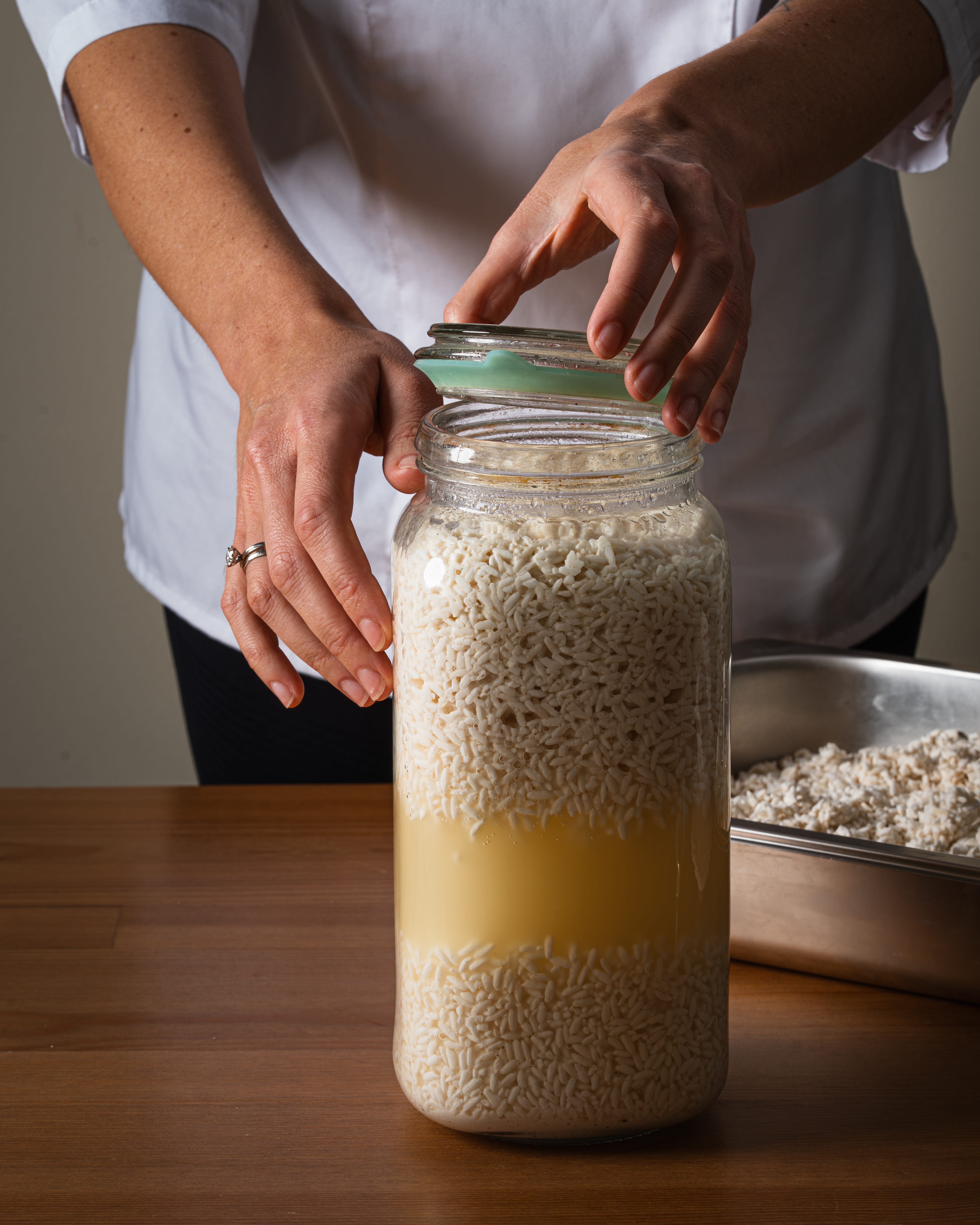
Sour amazake a less known brother of sweet amazake.
While both sour and sweet amazake rely on the metabolic power of koji (Aspergillus oryzae), sour amazake shifts the focus away from rapid sweetness and toward microbial balance, controlled acidity, and umami-driven complexity. It is not simply an unheated version of sweet amazake; it is a distinct fermentation ecosystem shaped primarily by temperature, time, and microbial succession.
Reference Point: Sweet Amazake
Sweet amazake is produced by holding rice and koji at 50-60C, a temperature range optimized for a- and ẞ-amylase activity, which is heat-driven saccharification.
These enzymes rapidly hydrolyze gelatinized starch into glucose and maltose, creating high sweetness in a short time (7-10 hours).
At these elevated temperatures, lactic acid bacteria growth is inhibited, and proteolytic enzymes play a minor role.
The result is a clean, sweet, low-acidity beverage with limited umami development.
Fermentation Dynamics
Sour amazake ferments at 20-23C, where koji enzymes remain active but operate more slowly.
Amylases gradually convert starch into fermentable sugars, while acid proteases and peptidases break rice proteins into amino acids and small peptides.
This balanced enzymatic activity increases umami, mouthfeel, and savory depth, creating a substrate not only for sweetness, but also for subsequent microbial fermentation and flavor layering.
Slower conversion, broader flavor formation.
This environment strongly favors lactic acid fermentation. Lactic acid bacteria (LAB) are naturally present on koji rice, cooled cooked rice, and in the environment. At moderate temperatures, mesophilic LAB such as Lactobacillus and Leuconostoc proliferate without added starters. Crucially, the 20–23C range encourages LAB dominance over less desirable microorganisms. Yeasts remain largely inactive, preventing alcohol production, while spoilage bacteria are outcompeted as acidity begins to develop. Temperature here is not incidental—it is selective pressure.
These bacteria metabolize glucose and maltose into lactic acid, gradually lowering pH. This acidification is not abrupt or aggressive. Instead, it progresses in parallel with enzymatic sugar release, allowing the ferment to self-regulate. Acidification stabilizes the ferment, suppresses spoilage microbes, and introduces soft, rounded acidity rather than sharp sourness. The result is a profile closer to yogurt whey or lightly cultured rice water than to vinegar or kombucha.
From a beverage perspective, this makes sour amazake unusually versatile. It is refreshing yet savory, acidic but restrained, and structurally stable.
Sounds like a starter for lacto-fermented sodas that also layers your beverage with umami, doesn’t it?
Because sugars are still present but partially consumed, sour amazake can support secondary fermentations, carbonation, or flavor infusions without becoming cloying or volatile.
Temperature is Your Control Tool
The entire process hinges on thermal restraint and precision. The process unfolds in two phases. During the first 2-3 days at 20–23°C, enzymatic saccharification and LAB growth occur simultaneously, building sugars, amino acids, and acidity. This phase is dynamic and biologically active, requiring daily stirring to redistribute nutrients, oxygen, and microbes evenly. Stirring also prevents development and ensures uniform enzyme access.
Once the desired balance begins to emerge, refrigeration becomes essential. Refrigeration below 6C slows microbial metabolism while enzymatic reactions taper off. LAB activity is not stopped entirely, but it is significantly reduced, allowing the ferment to stabilize rather than continue acidifying unchecked.
This cold conditioning stabilizes pH, prevents over-acidification, and allows flavor integration, resulting in a clean, complex, mildly sour amazake with pronounced umami. Time in the cold becomes a refinement stage rather than an active fermentation phase.
Sour Amazake Core Recipe
Ingredients:
• 700 gr Koji Rice
• 1000 gr Water
Instructions:
Mix well all the ingredients at room temperature. Make sure all the rice is submerged.
• Ferment at 20–23°C for 3 days. Stir EVERY DAY.
• Strain off the grains.
• At this stage, you may add flavoring agents (fruit, herbs, spices) for the secondary fermentation.
• Ferment in the fridge for up to 3 days—the longer you ferment, the more acidity it develops.
• Strain through a chinois, then through a super-bag (nut milk bag).
Store below 6°C for up to 7 days.
