


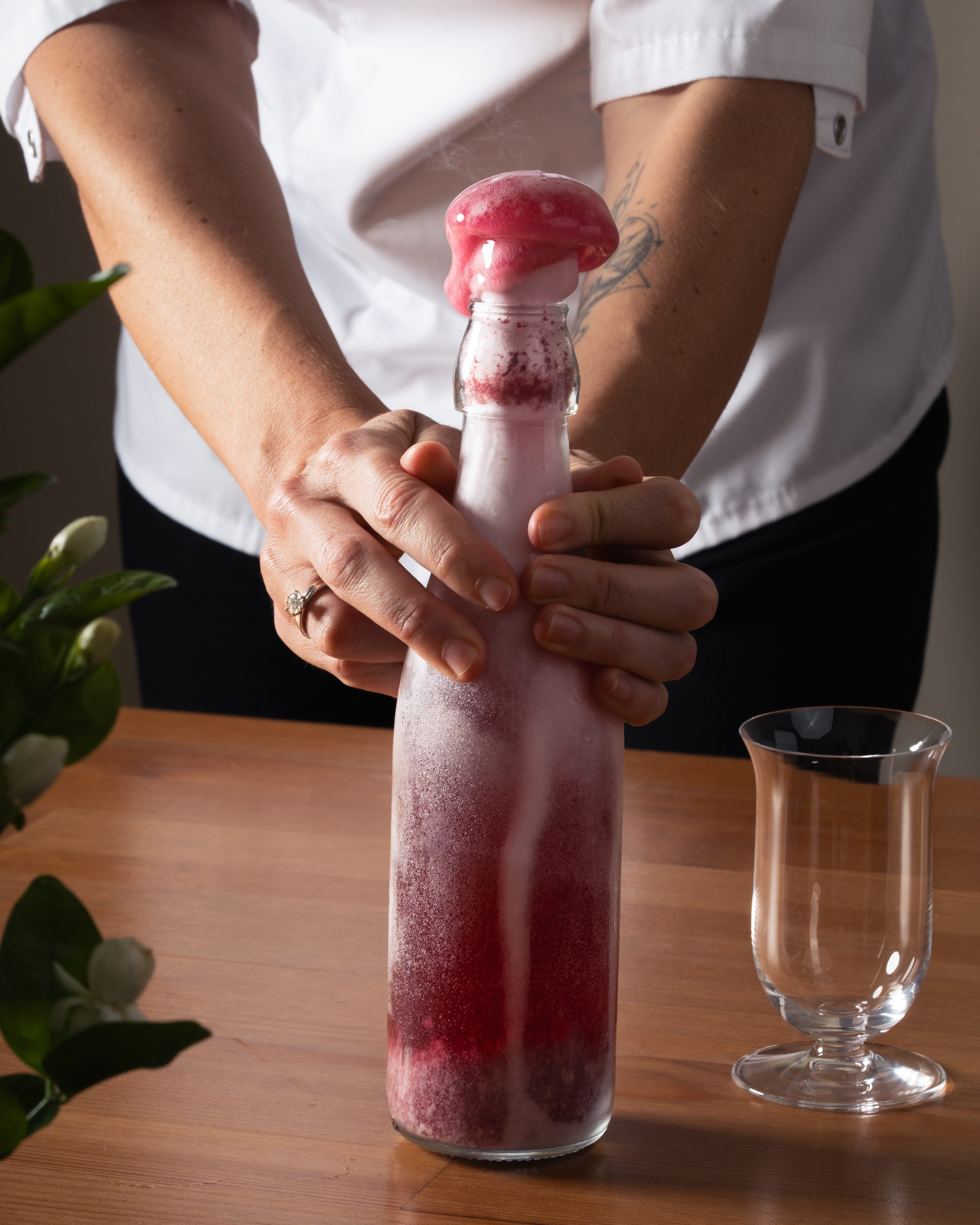
The Type of Fermentation
Lacto-fermentation is driven by lactic acid bacteria (LAB), mainly Lactobacillus and related genera. They convert sugars into lactic acid and use the energy to grow. The acid lowers pH and protects the drink from spoilage organisms.
Kefir whey, water kefir, sourdough starter and koji-based sour amazake are not pure cultures. Each contains LAB and yeast living together. Both groups eat the same sugars, so the balance between them decides the result.
Why Sugar Sets the Balance
Sugar is the fuel for both groups. With too little, LAB acidify slowly. With too much, yeast receive a surplus and push the drink toward ethanol and CO₂.
A powdered mono-strain starter avoids this problem because yeast are absent. A mixed starter does not, so we control the sugar instead. The working target is about 10 g of total sugar per 100 g of finished mixture (10% w/w, roughly 10 °Bx).
• Below 8 g/100 g: acid builds slowly and pH stays in a range where unwanted microbes survive.
• 8–12 g/100 g: enough fuel for confident acidification, with yeast activity manageable.
• 12–20 g/100 g: surplus fuel for yeast. Ethanol, pressure and a heavy sweet profile become likely.
• Above 20 g/100 g: osmotic pressure starts to inhibit all microorganisms, LAB included.
Temperature works together with sugar. Warmth speeds up yeast as much as LAB, so a warm ferment without a strong starter drifts toward alcohol. Hold the batch at 20–22 °C.
LAB rarely use all the sugar. Fermentation stops when acid accumulates (pH about 3.3–3.6), not when fuel runs out. Residual sugar in the finished soda is normal.
How to Calculate Sugar When Fruit Provides It
The 10% target is total sugar, and it includes the natural sugars of the fruit. Often you add little table sugar, or none.
On a puree label, find the carbohydrates line, then the line below it: “of which sugars” (g per 100 g). For fresh fruit, reference values vary by 30–50% with cultivar and ripeness, so confirm with a refractometer before fermentation starts.
• S: target concentration, g/100 g (10)
• m_mix: total batch mass, g
• m_i: ingredient mass, g
• s_i: sugars in the ingredient, g/100 g
1. Total sugar needed: M_total = S × m_mix ÷ 100
2. Sugar from the ingredient: M_source = m_i × s_i ÷ 100
3. Sugar to add: M_add = M_total − M_source
4. Water: m_mix − m_i − M_add − m_starter
If M_add is negative, the ingredient carries too much sugar. Reduce its mass to no more than S × m_mix ÷ s_i.
Recipe: Blueberry Lacto-Fermented Soda (1,000 g batch)
Ingredients
• 400 g frozen blueberry puree, no preservatives (52 g sugar at 13 g/100 g, flavor base)
• 48 g table sugar (brings total sugar to 100 g, 10% w/w)
• 50 g kefir whey (starter; its sugar is minor and ignored)
• 502 g water (completes the 1,000 g batch)
Method
1. Combine puree, sugar and water. Stir until the sugar dissolves completely.
2. Measure °Bx and pH. Target 10 °Bx; record the starting pH.
3. Adjust the temperature to 20–22 °C.
4. Add the whey and stir.
5. Ferment covered at 20–22 °C for 48–72 hours. Check pH daily until it reaches 3.3–3.6.
6. Strain and bottle. Chill to 4 °C to slow fermentation.
Track pH, not °Bx, once fermentation starts. Alcohol and acid shift refractometer readings, so the °Bx value after the start is unreliable.
Skip the arithmetic
I built a simple Excel calculator for exactly this. Enter the "of which sugars" value from your puree label, the ingredient mass and the total batch mass in grams. It returns the sugar the ingredient already provides, how much table sugar to add, how much water completes the batch, and a check that you land inside the 8–12 g/100 g range. It is available for $10.5 here: Sugar Calculator for Fermentation.